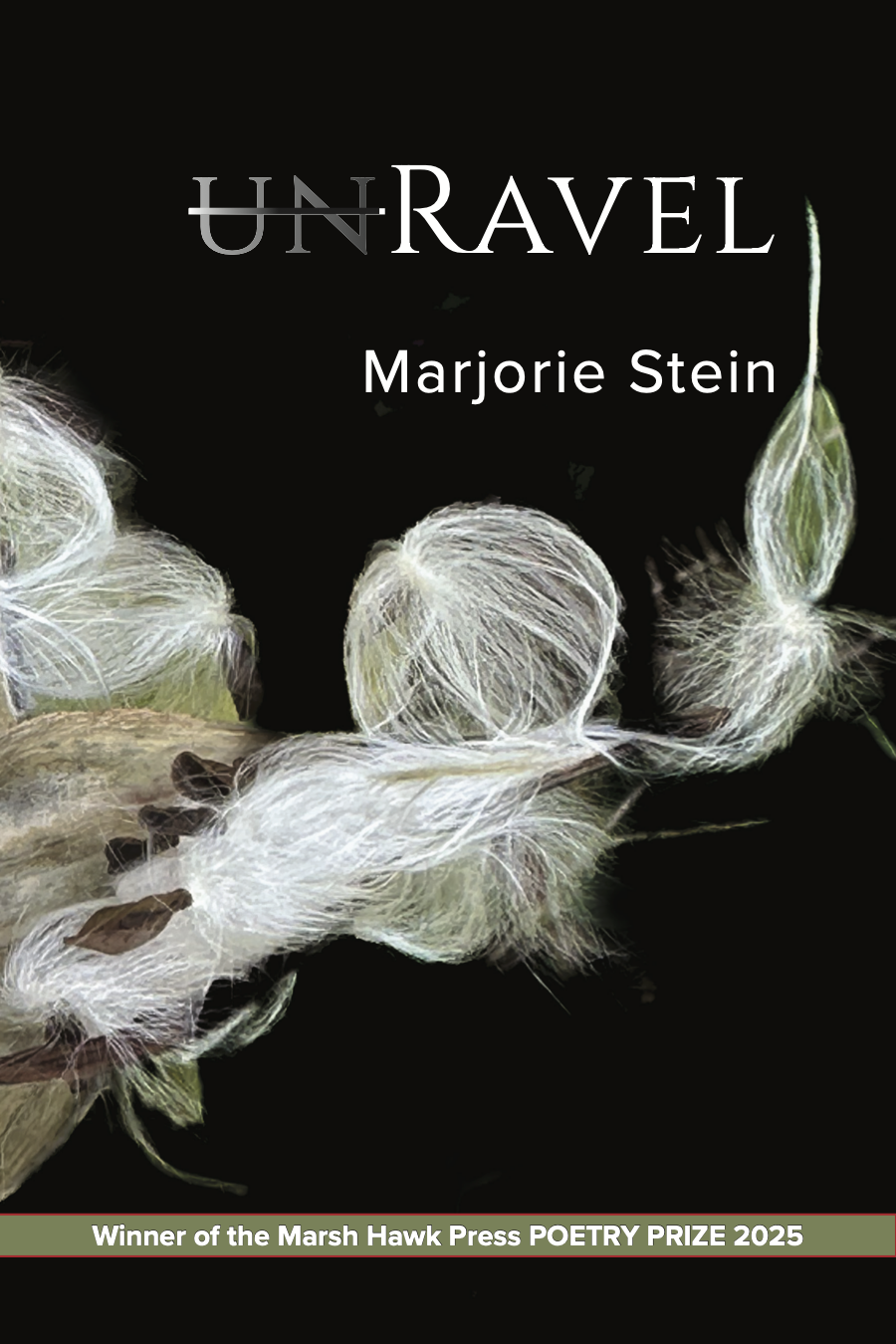
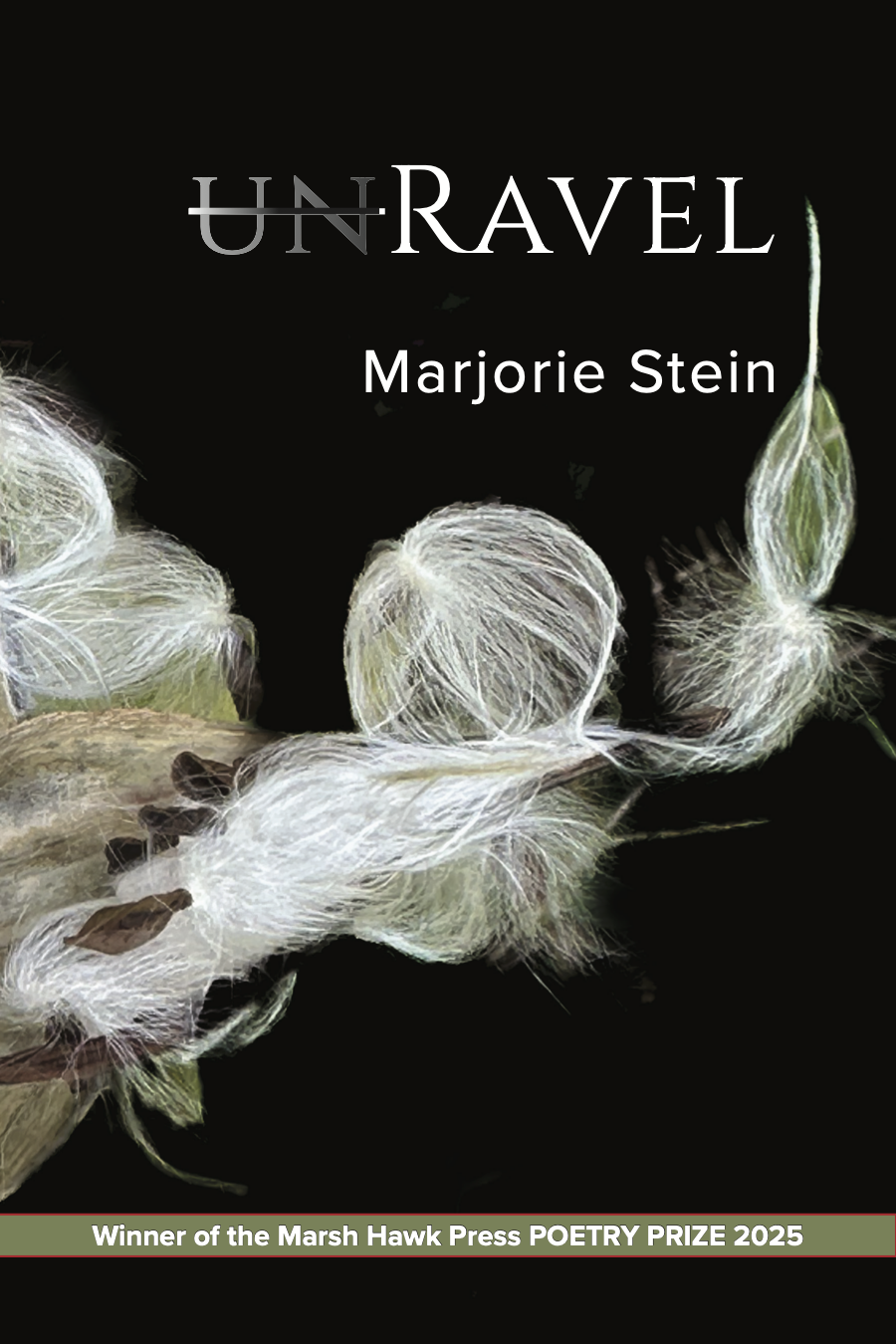
unRavel
Winner of the 2025 Marsh Hawk Press Poetry Prize
A mind-expanding poetry collection for readers who crave big ideas and bold imagination. Unravel zooms out to the cosmic scale—time, space, uncertainty—while staying razor sharp in language and wit. It’s the book writers reach for when they want to think differently, dream bigger, and rediscover awe.
“In an age when we get lost in the particulars, unRavel boldly embraces a cosmic perspective. I marvel at the ability of this work to span vast stretches of time and space with precise, elegant language and a quick, playful intelligence. UnRavel is a book that revels in the uncertainty of knowing where we are and where we’re headed collectively and, closer to home, personally. One poem describes “cartographic failures,” while another cooly states “the mirage arrives/twice daily/telling us we’re/using the wrong maps.” Trusting the tools of sound and intuition, these poems take a human measure of the universe. This writing is filled with somber misgivings and stunning beauty. Even when we are lost, there is a sense of adventure and awe in our lostness.”
—Elaine Equi, Contest Judge of the 2025 Marsh Hawk Press Poetry Prize
In these dark will-they-ever-pass days when one wants to savor the sky, the sun, and the plants that keep delivering oxygen against all odds, there’s no place I’d rather be than with Marjorie Stein’s unRavel. These lyrics are unparalleled in their sonorous yet deftly plain-spoken commitment to cosmic wonder. Stein is a steady journeyer whose exquisite, multifaceted maps are as inventive as they are impossible to not follow. Plus, Stein is egoless! “[Her Name erased from the Poem].” Stein knows “the cold metal of being the last one,” but nevertheless “begins the hero’s journey/wearing one shoe, dragging/along her opinions in a cart.” A gem, companiable, essential reading for our times. Carry unRavel with whatever you have left to carry.
—Gillian Conoley
Marjorie Stein gives us the world simultaneously unraveling and raveling, its components swirling in a way that has them both glittering and questioning. Her love of all the detail that surrounds us is evident through an acute attention that creates surprising connections—birds appear where we don’t expect them; language arrives “haiku-cloaked”—and all is delivered in a gorgeous wash of sound. Every page brings a surprise that is both frank and reaffirming.
—Cole Swensen
Marjorie Stein’s excellent book, unRavel, tells no stories but rather revels in the language itself, a dramatic storm of words. In “Blooming in Thermal Drafts,” for instance: “blister-hinged witherings / scar the seam between / erased mothers, children, / stuffed animal, mitten, tuneless hum / shivering in the naught.” The excitement is in the naming and surprising turns of phrase. It reminds me of Penelope’s own odyssey of weaving by day and unweaving by night. But the same poem also contains a cradlesong, the calm after the storm.
—Paul Hoover
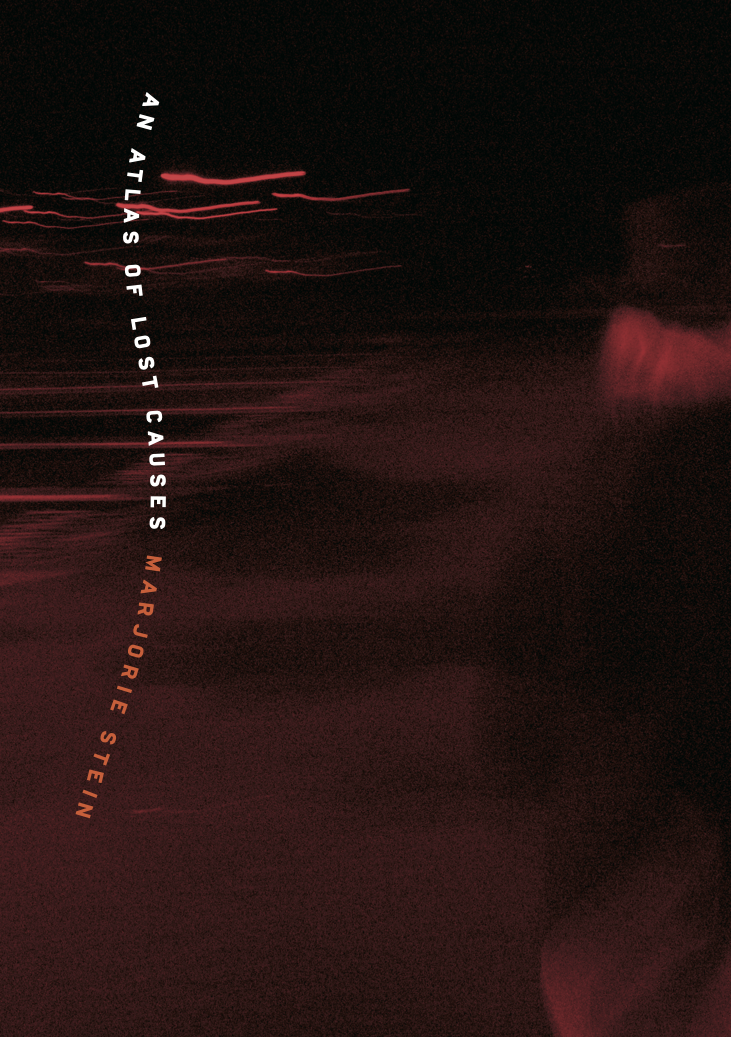
An Atlas of Lost Causes
Kelsey Street Press, 2011
An Atlas of Lost Causes by Marjorie Stein pulls the reader into a rich, internal world where perception is doubled and “stars are just dead light falling behind schedule.” As her poetic noir unfolds, quotidian detail accumulates as evidence of human scenarios bleeds into the infinite: “You know how sometimes, at night in a city, you may hear someone crying out in distress? The stains were that sound and shape, spilled in a darkness that smashes into awareness.” At the core of the work are the narrator's attempts to understand the mystery surrounding her twin sister and an unnamed crime. Her contemplations circle around references to camera obscura, Muybridge photographs, Marlene Dietrich, and more, all in an effort to fathom how each human life must eventually end. Yet as the narrative progresses, the reader is led to wonder: Is it the twin’s disintegration, or the narrator’s, we watch unfold? Original line drawings accompany the text.
“Marjorie Stein’s An Atlas of Lost Causes brings one right to the brink of and then through what great books are supposed to do: give us that charge of recognition we so long for. In this world we are and are no longer misfits, indeterminate twin sisters, murderers, lonely folks born “somewhere between the Industrial Age and the Information Age,” wondering what it is to be human, what it is to be handed one life, and yet experience it so polymorphously. Smart, charming, disarming (“Some people may consider this good funeral weather” and “knowing no amount of language can cure the hole”), this is a book for the age and the ages.”
—Gillian Conoley
“The murder mystery written as asymptote—throughout her exquisitely careful and relentless layering of stunning phrase after stunning phrase, we feel Stein getting closer and closer, forever approaching an impossible and unidentified crime that she’s exploring ever more minutely all the time. Her tools of exploration are a twin sister, a camera obscura, one-way ephemera, an iridescent death, and much, much else, all set on the trail of all that cannot be named, or our desperate desire for it. A jubilantly haunting work.”
—Cole Swensen